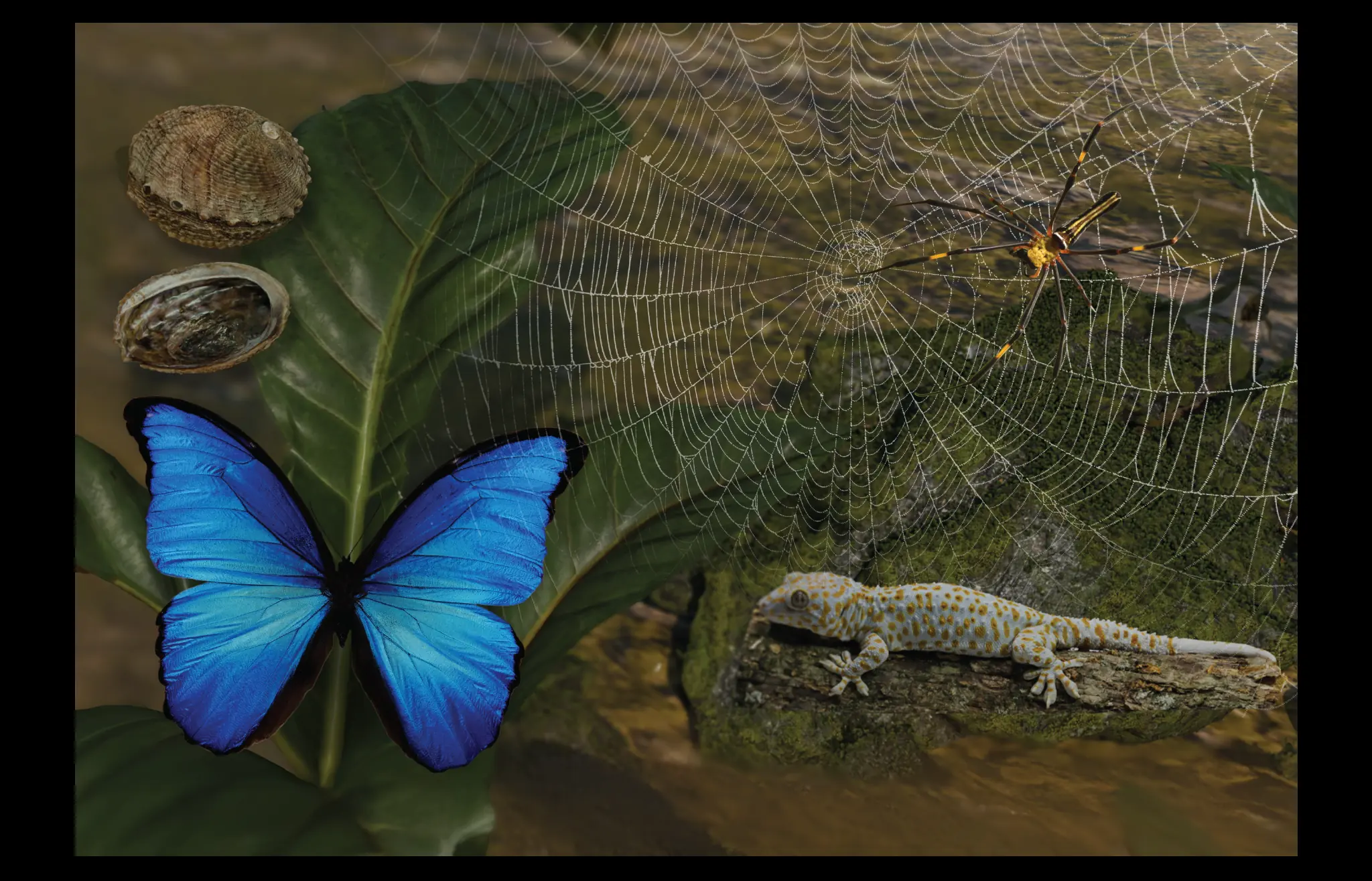
Welcome to the extraordinary world of nature's material masters, where organisms have developed substances and surfaces that routinely outperform our most advanced synthetic materials in efficiency, multifunctionality, and environmental compatibility.
A golden orb weaver spider dangles from its web, spinning silk so strong that, scaled to human size, it could stop a jetliner in flight. This remarkable fiber — five times stronger than steel yet more elastic than rubber — forms at ambient temperature using only digested insects and water as raw materials. Unlike synthetic fibers requiring toxic solvents and extreme conditions, the spider extrudes this extraordinary material through specialized spinnerets that transform liquid protein into structural masterpieces.
Along a California coastline, a red abalone clings to a rock amid crashing waves that would shatter conventional ceramics. Its shell, composed primarily of calcium carbonate — the same compound found in chalk — achieves impact resistance 3,000 times greater than its primary mineral component. This extraordinary toughness emerges not from exotic elements but from a precise structural arrangement: microscopic calcium carbonate tablets arranged in a brick-and-mortar pattern with protein layers just nanometers thick.
In a tropical rainforest, a gecko races upside-down across a leaf's slick surface, its toes making and breaking contact 15 times per second. Each toe pad contains hundreds of thousands of microscopic hairs that branch into structures so small they interact directly with individual molecules on the leaf's surface. This molecular-scale interaction creates adhesion strong enough to support the gecko's weight yet requires no energy to disengage — simply peeling away with each step.
Elsewhere, a blue morpho butterfly flutters through dappled sunlight, its wings flashing an electric blue visible from half a mile away. Yet this vibrant color contains no blue pigment whatsoever. Instead, microscopic scales on the wing surface create spaced ridges that cause light waves to interfere with each other, allowing only blue wavelengths to reflect back to our eyes.
Nature's Material Advantage: By the Numbers
| Natural Material | Human Technology | Performance Gap | Key Metrics |
|---|---|---|---|
| Spider Silk | High-tensile steel | >5× stronger by weight | 1.2 GPa tensile strength; absorbs 3× more energy than Kevlar; produced at room temperature |
| Abalone Shell (Nacre) | Industrial ceramics | 3,000× tougher | 95% mineral, 5% protein; layered aragonite tablets deflect cracks across thousands of boundaries |
| Gecko Adhesion | Industrial adhesives | Zero residue; millions of cycles | Leaves zero residue; self-cleaning; reversible across diverse surface types |
| Morpho Structural Color | Pigment-based coatings | Color remains vibrant >100 years | Reflects 100% blue light via nanostructures; never fades under UV; no dyes or pigments required |
| Plant Self-Healing | Engineered polymers | ~10× faster repair | Seals in minutes using lipids and waxes; structural reinforcement within hours |
| Mussel Adhesion | Underwater epoxies | Cures underwater; no surface prep | Forms permanent bonds in saltwater with no external energy; adheres to any substrate |
| Mother-of-Pearl | Industrial composites | ~1,000× greater material efficiency | Exceptional toughness with 95% mineral + 5% protein; engineered equivalents need >30% binder |
Table 1.1 — Comparative Performance Between Natural Materials and Human-Engineered Equivalents
Natural Composites: Nature's Layered Wonders
Chalk — made of calcium carbonate — crumbles with the slightest pressure. Yet abalone shells, made primarily of this same compound, withstand crushing ocean waves and predator attacks. This transformation from fragile mineral to robust armor represents one of nature's most instructive engineering lessons: properties emerge not just from what materials are made of, but from how they are organized.
The abalone's secret lies in nacre — or mother-of-pearl — an intricate composite that achieves impact resistance 3,000 times greater than the aragonite (a form of calcium carbonate) it's made from. Under a microscope, nacre reveals a stunning architecture: hexagonal tablets of aragonite, each about 10 micrometers wide and 0.5 micrometers thick, stacked in offset layers and bonded together by thin sheets of elastic protein. This is the same brick-and-mortar pattern used in modern construction — but executed at the nanoscale with extraordinary precision.
When stress strikes the shell, this architecture performs a remarkable trick. Rather than propagating straight through like a crack in ordinary ceramic, the fracture must navigate an obstacle course: deflecting around tablets, jumping between layers, pulling apart protein bonds that absorb energy. The result is a material that dissipates fracture energy across thousands of boundaries rather than concentrating it at one point.
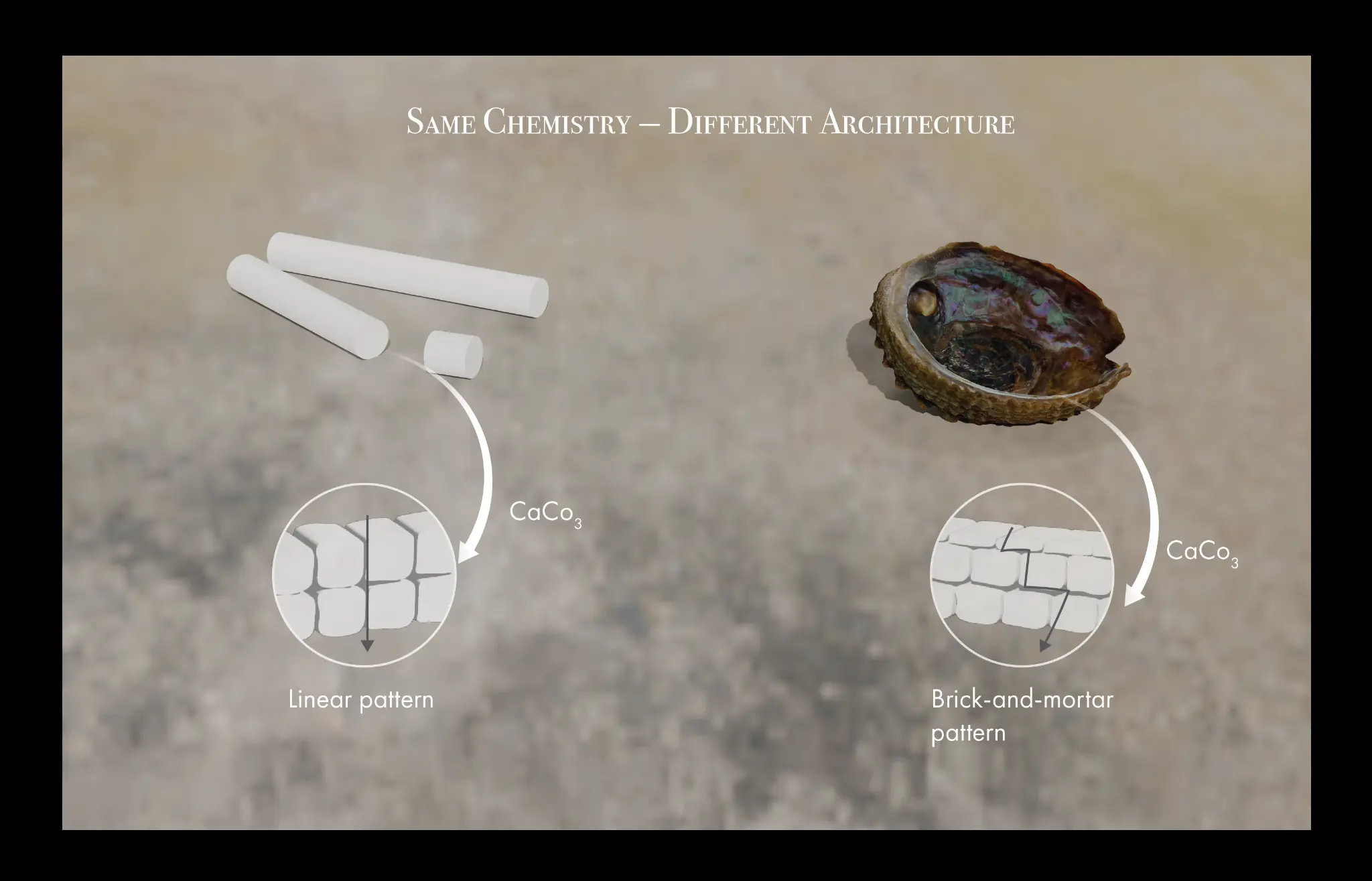
Nature's ceramic masterpiece: hexagonal aragonite tablets in a brick-and-mortar arrangement, achieving impact resistance 3,000× greater than the base mineral through structural arrangement alone.
The most advanced engineering ceramics humans have developed can achieve toughness perhaps 5–10 times greater than their base materials through careful manufacturing. Nature's abalone achieves 3,000 times improvement using nothing but calcium carbonate and protein — materials so common they're found in chalk and egg whites. The difference isn't the ingredients; it's three billion years of architectural refinement.
Biomimetic Composites
- Medical implants: Nacre-inspired layered ceramics for bone replacement that match the mechanical properties of natural bone while resisting fracture.
- Building materials: Companies like Biomason grow construction materials using microorganisms, borrowing nature's approach to mineral deposition.
- Aerospace components: NASA has developed layered composites inspired by nacre's architecture that achieve superior impact resistance for spacecraft shielding.
Sticky Situations: Attachment Without Glue
While the abalone creates structural masterpieces underwater, other creatures achieve similar material magic in the air above. A gecko's adhesion system represents one of nature's most elegant engineering solutions — creating controllable attachment through pure physics, with no chemistry whatsoever.
Each square millimeter of gecko toe pad contains about 14,400 hair-like structures called setae, each roughly 100 micrometers long. But the real magic happens at the tips. Each seta branches into hundreds of spatula-shaped structures just 200 nanometers wide — small enough to interact with individual molecules on a surface through van der Waals forces, the weak electromagnetic attractions that occur between all molecules at extremely close range.
Individually, these forces are negligible. But a gecko has approximately 6.5 million setae on each foot, collectively generating enough van der Waals attraction to support the animal's weight many times over. More remarkably, the system disengages simply by changing the angle — pull the toe toward the surface and it sticks; bend it back and it releases instantly. This surface creates attachment through structure alone — no sticky secretions, no chemical bonds, just precisely arranged physical elements.
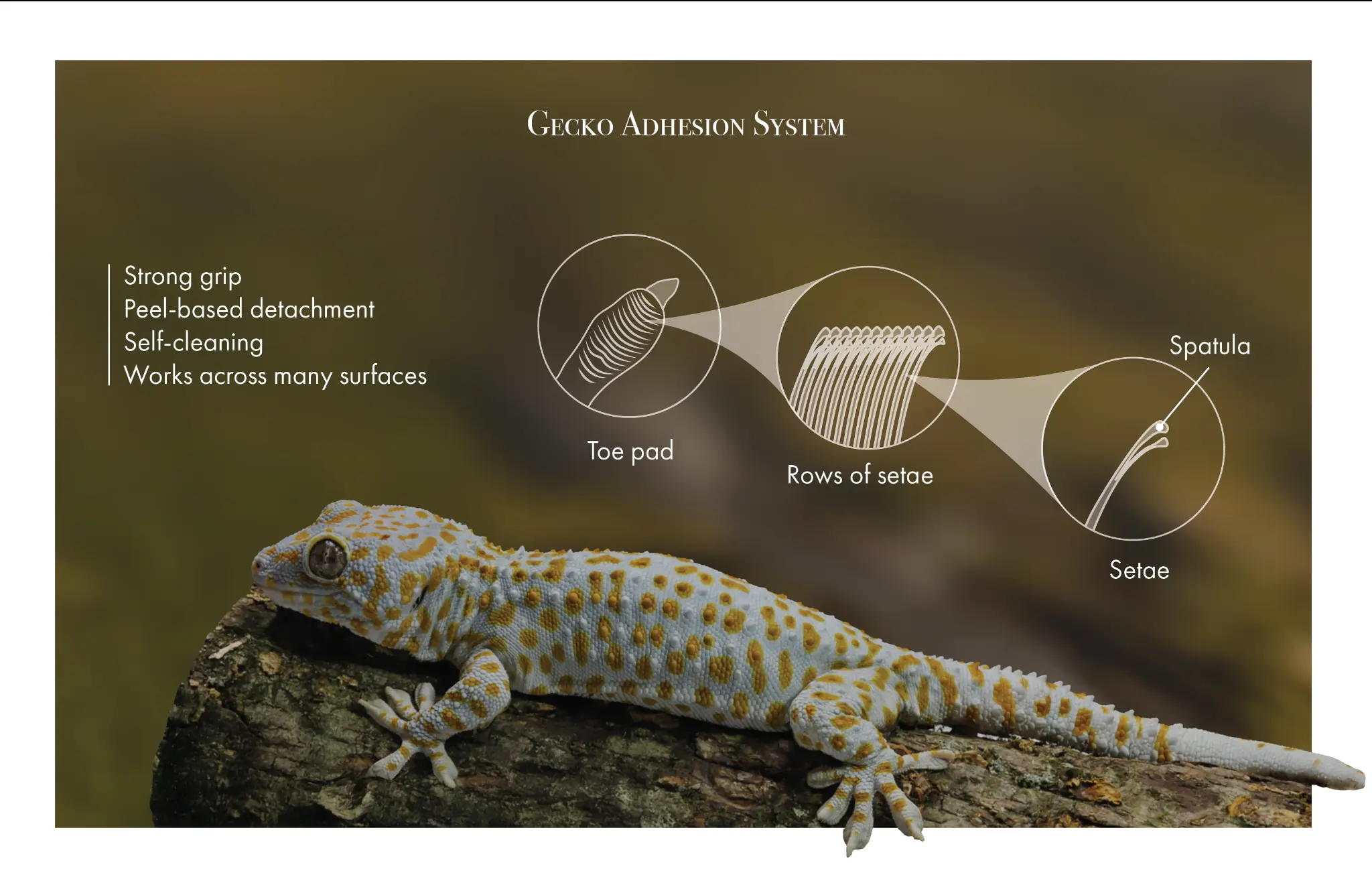
From macro to nano: hierarchical setae architecture enabling direction-controlled, self-cleaning adhesion through van der Waals forces alone — no glue, no residue, millions of cycles.
A single gecko toe can support 40 times the animal's body weight. Scaled to human dimensions, the van der Waals forces across a human-sized gecko foot would be sufficient to support a small car — all through molecular proximity alone, with no adhesive chemistry whatsoever.
Nature's Amazing Fibers: Stronger Than Steel
In a quiet corner of a garden, a golden orb weaver spider (Nephila clavipes) spins silk so remarkable it makes the most advanced synthetic fibers seem primitive by comparison. This extraordinary material — stronger than steel by weight yet more elastic than rubber — forms at room temperature using only digested insects and water as raw materials.
Spider dragline silk achieves tensile strength of approximately 1.2 gigapascals — comparable to high-grade steel — while stretching up to 40% before breaking. This combination of strength and extensibility creates exceptional toughness, allowing spider silk to absorb three times more energy before breaking than Kevlar, the material used in bulletproof vests.
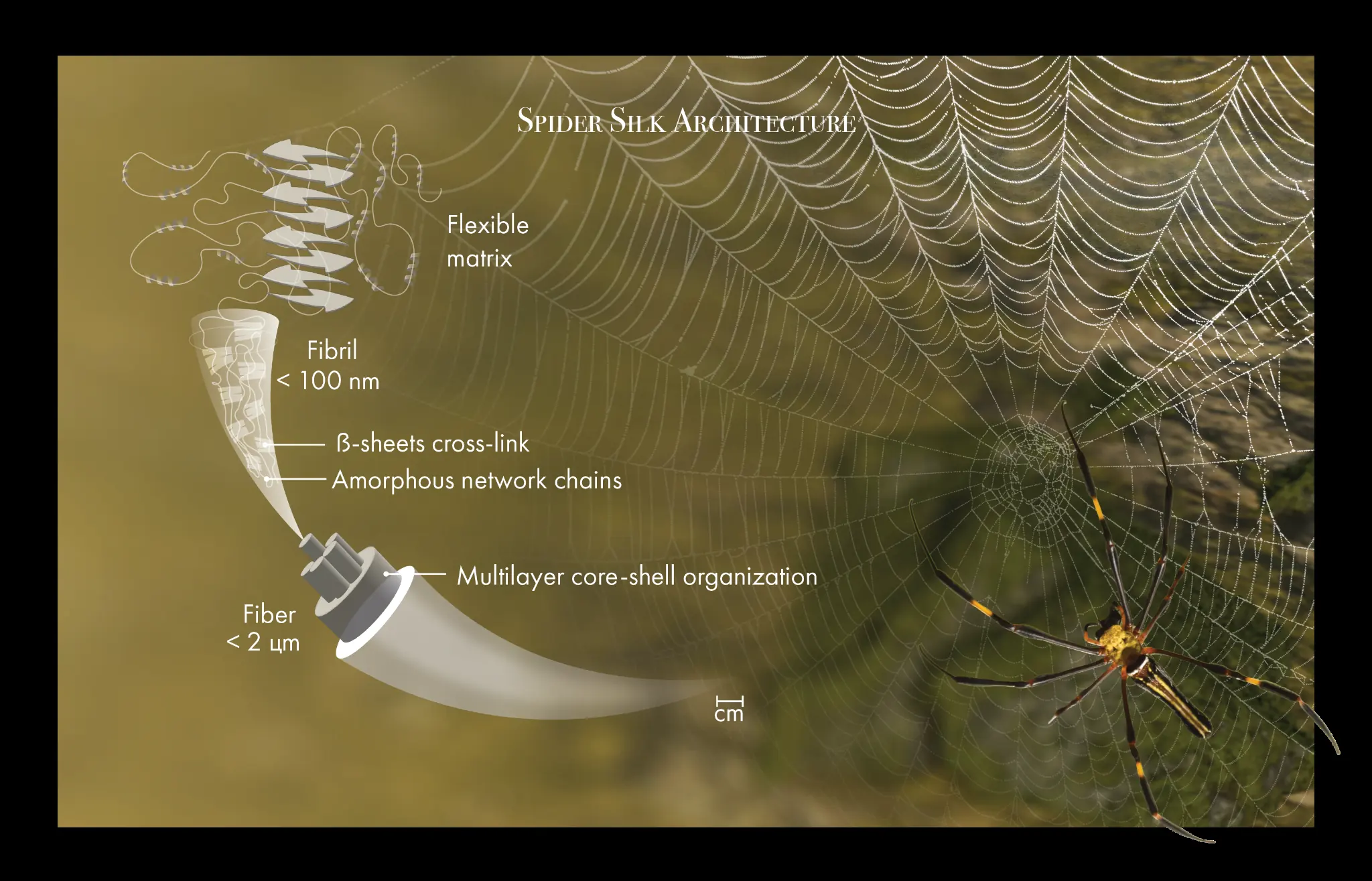
Stronger than steel by weight, spider silk forms at ambient temperature using only water and proteins — achieving exceptional strength and elasticity with minimal resources.
A spider's silk production system is so efficient it can create an entire web using protein equivalent to just 0.1% of its body weight. Scaled to human terms, this would be like building a suspension bridge using less than two ounces of material. A single golden orb weaver can produce up to seven distinct silk types with different mechanical properties, each optimized for specific functions.
"In the spider's abdomen lies a factory that would make any materials engineer envious — producing fibers stronger than steel using only water, ambient temperature, and yesterday's flies."— Dr. Fritz Vollrath, Evolutionary Biologist and Spider Silk Researcher
What makes this natural fiber even more remarkable is its sophisticated molecular architecture. Within each silk fiber, protein molecules arrange themselves like perfectly stacked bricks to create regions of exceptional strength. Between these crystalline islands, elastin-like proteins form flexible zones that give the silk its remarkable extensibility. When stretched, these regions unfold like molecular springs, then return to their original configuration when tension releases.
Beyond Conventional Textiles
- Medical applications: Researchers have developed silk-based sutures, ligament replacements, and drug-delivery scaffolds that are both strong and biocompatible.
- Protective fabrics: Companies like Kraig Biocraft Laboratories engineer silkworms to produce spider silk proteins, creating high-performance fibers for body armor and cut-resistant clothing.
- Biodegradable alternatives: Bolt Threads has commercialized Mylo, a mushroom-based mycelium leather, inspired by how nature assembles strong materials from biological building blocks.
Living Color: Paint Without Pigments
The iridescent blue of a Morpho butterfly's wings can be seen from half a mile away — a brilliant, electric color so vivid it seems almost to glow from within. Yet if you were to grind these wings into powder, the blue would vanish completely. Unlike most colors we encounter, which come from pigments that absorb certain wavelengths of light, the Morpho's blue is entirely structural — created by the physical interaction of light with precisely engineered nanostructures.
Under an electron microscope, each wing scale reveals a forest of microscopic ridges, each shaped like a Christmas tree with branches spaced at intervals precisely matching the wavelength of blue light (about 450 nanometers). When light strikes these structures, waves reflected from different layers travel slightly different distances. Blue wavelengths — those traveling exactly the right distance — constructively interfere, amplifying each other and reflecting brilliantly. All other wavelengths destructively interfere, effectively canceling each other out.
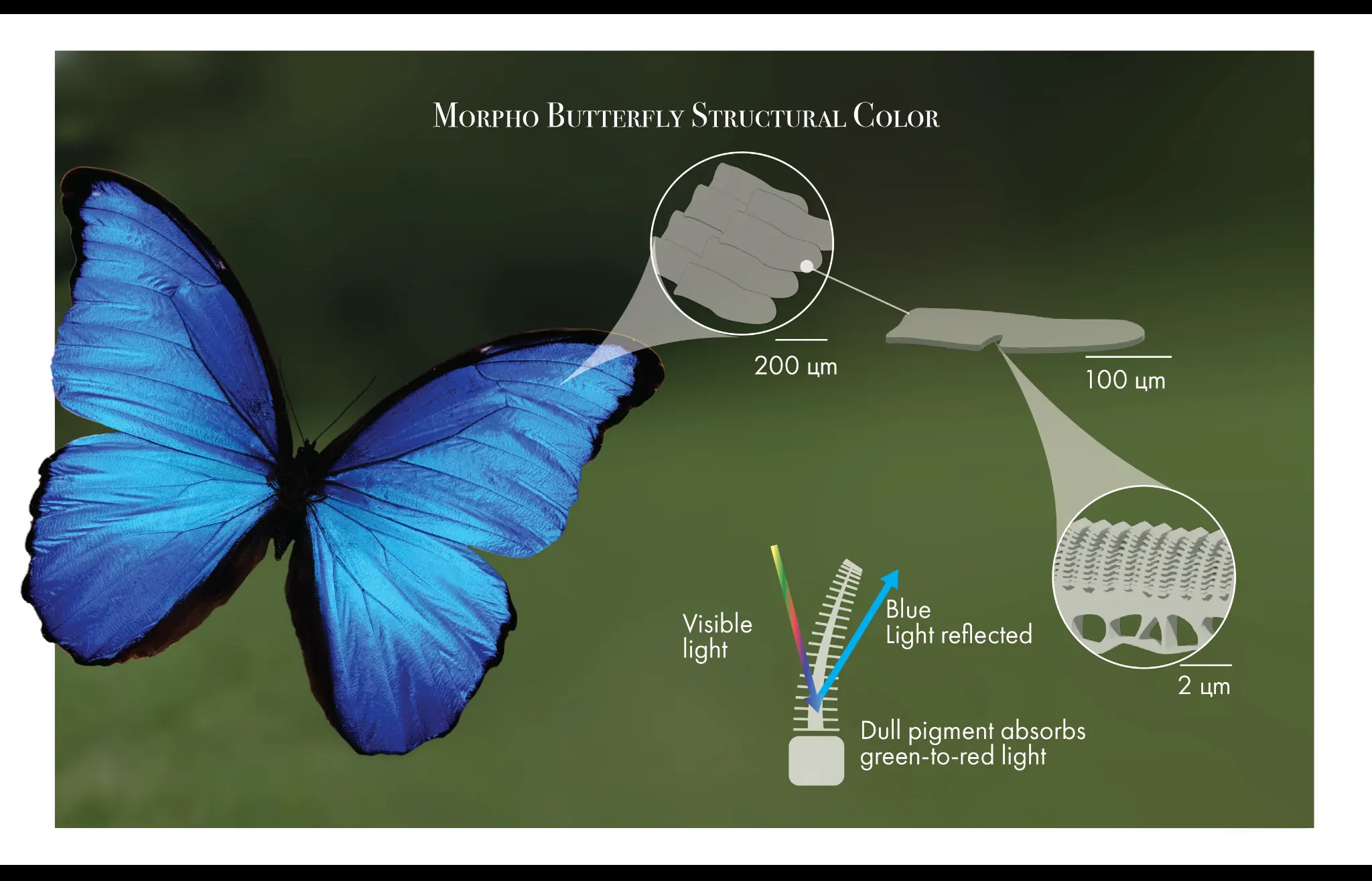
Nanostructured wing scales create vivid blue through light interference — no pigment, no fading, visible from half a mile. A masterclass in photonic engineering refined over millions of years.
Structural colors in the Morpho butterfly have remained unchanged in museum specimens for over 100 years — far outlasting any pigment-based color. The color isn't in the material; it's in the geometry. Change the spacing, change the color. This explains why the wings flash different shades as the viewing angle changes — the same light-wave physics that creates rainbows in soap bubbles.
Nature's Repair Kits: Self-Healing Wonders
Imagine building materials that automatically repair scratches overnight, medical implants that fix their own microfractures before they grow dangerous, or aircraft skins that seal punctures autonomously mid-flight. While these capabilities remain largely aspirational for human engineering, the natural world has been implementing self-healing systems for hundreds of millions of years.
Plant cuticles — the waxy outer coating of leaves — demonstrate a multi-stage repair system of extraordinary sophistication. When damaged, the cuticle deploys different mechanisms depending on severity. Minor scratches trigger an immediate response: lipid molecules reorganize to seal the breach within minutes, reforming the protective surface. More substantial damage activates a second phase: callose, a temporary structural polysaccharide, deposits across the wound to provide immediate mechanical reinforcement while slower-responding repair systems mobilize.
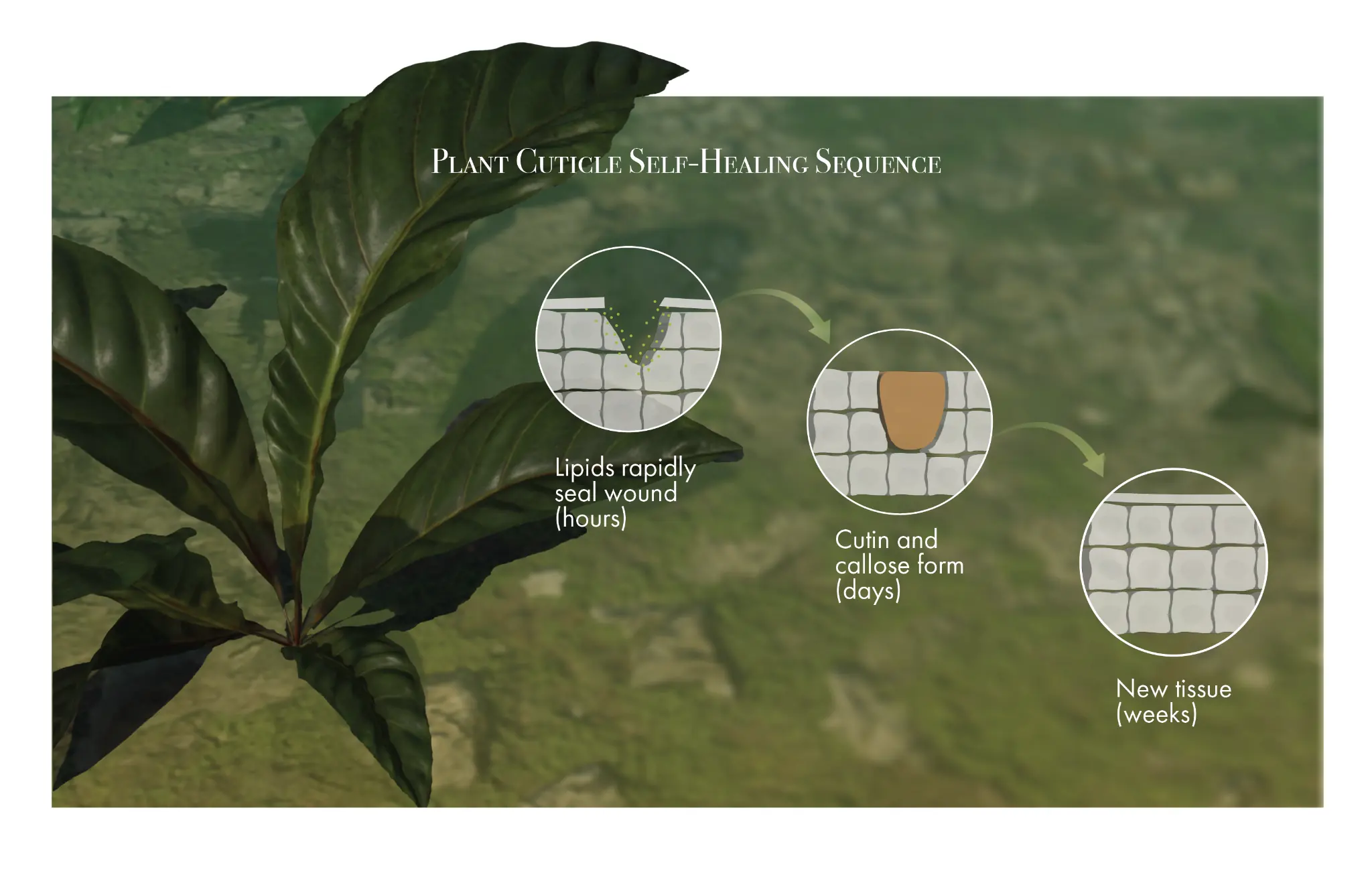
Three-phase repair: lipid reflow seals the breach in minutes; callose provides structural reinforcement within hours; full regeneration completes in days — without scaffolding or external energy.
Human-engineered self-healing materials typically heal 60–70% of original strength in 24 hours under controlled laboratory conditions. Plant cuticles routinely achieve 95–100% restoration within 48–72 hours under ambient outdoor conditions — in rain, wind, and temperature fluctuations that would challenge any laboratory material. And they've been doing it for 400 million years.
Self-Healing Breakthroughs
- Infrastructure materials: Researchers at Delft University have developed concrete containing bacteria that produce calcium carbonate to fill cracks — inspired directly by biological mineralization.
- Aerospace coatings: Boeing and Airbus are testing paint systems with microcapsules that rupture when scratched, releasing healing agents that seal the breach and prevent corrosion.
- Electronic displays: LG developed a self-healing coating for smartphone screens using polyurethane polymers that flow into scratches at room temperature, mimicking plant cuticle lipid mobility.