As a child exploring my garden, I watched ants march in organized lines, spiders spin intricate webs, and seedpods spiral gracefully to the ground. Like many, I was captivated by nature’s beauty—a fascination that has guided my life’s journey across continents and ecosystems, from the pulsing wetlands of the Everglades to the coral reefs of marine sanctuaries.
My career as an environmental scientist has granted me the privilege of studying Earth’s most remarkable places. Yet it took years to fully grasp what I was witnessing—not just fascinating biological phenomena, but sophisticated engineering solutions refined through billions of years of evolution. In moments of quiet observation, I began to see beyond the surface beauty to the genius operating in even the most ordinary creatures and processes.
This book emerged from a profound realization: The natural world is not just something to admire or protect for sentimental reasons—it is Earth’s most advanced research and development laboratory. For 3.8 billion years, through the elegant algorithm of natural selection, living systems have been continuously testing, refining, and optimizing solutions to the same fundamental challenges humanity now faces: how to create materials without toxic byproducts, how to move efficiently, how to store energy, how to process information, and how to build resilient systems that adapt to changing conditions.
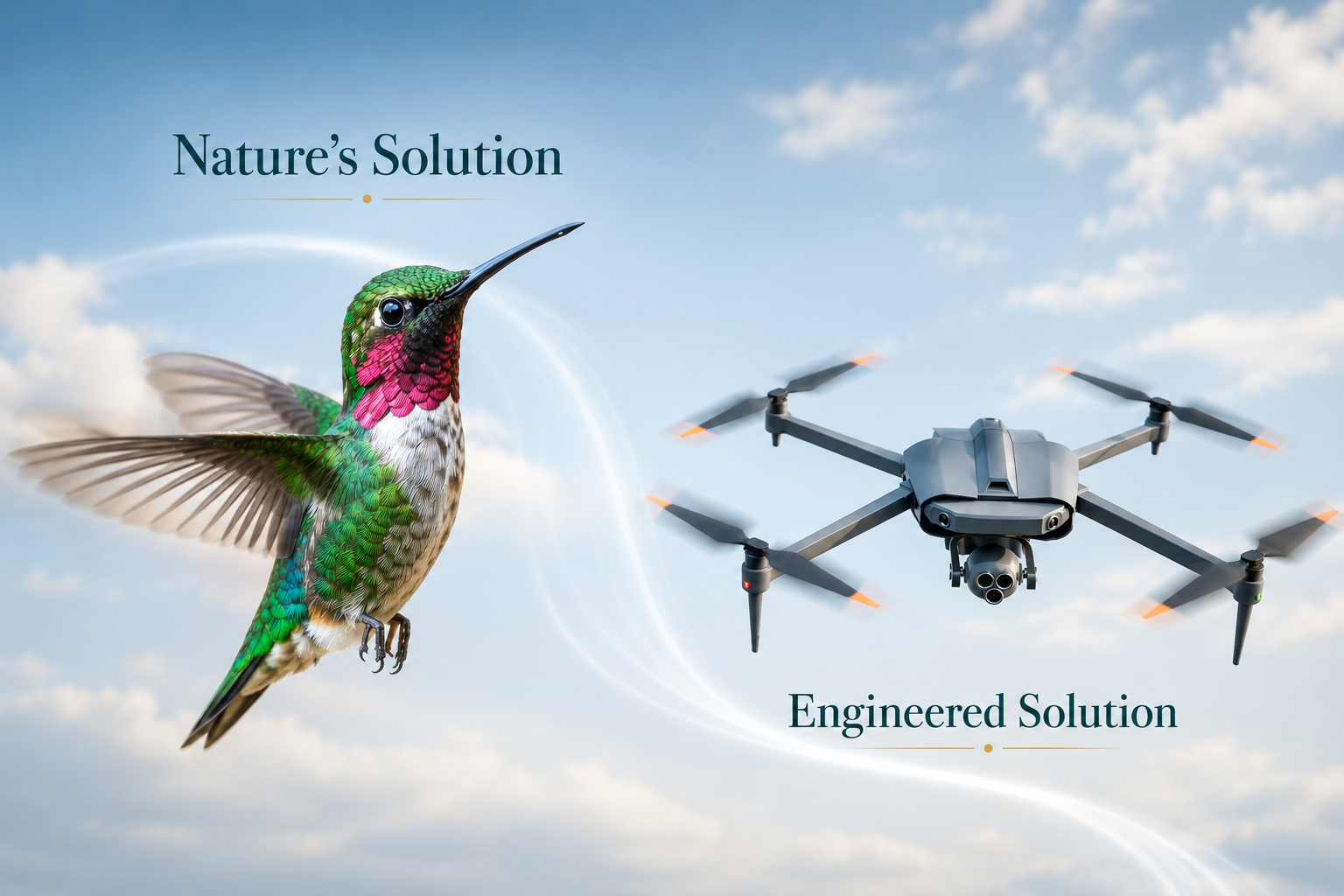
The solutions surround us everywhere, hiding in plain sight. The hummingbird hovering outside your window isn’t just a beautiful bird—it’s demonstrating flight capabilities our most advanced drones can barely approach; while managing energy with such precision, it can cross the Gulf of Mexico on less fuel than would fit in a thimble. The forest ecosystem isn’t just scenic woodland—it is implementing circular material economies that maintain productivity for millennia without depleting resources, where every output becomes input and the concept of waste doesn’t exist. The spider’s web isn’t just an interesting structure—it’s achieving strength-to-weight ratios that would astonish aerospace engineers working with advanced carbon composites, created at ambient temperatures with no toxic byproducts.
With each discovery, my perspective shifted—from seeing nature as something separate from technology to recognizing it as technology’s most sophisticated expression. I found myself approaching forests and coral reefs not merely as an admirer but as a student encountering master engineers with billions of years of experience. This apprenticeship to nature’s genius has transformed not just my research but my entire worldview.
In this book, I’ve distilled the essence of my three-volume series into a single, accessible journey through nature’s engineering marvels. From spider silk stronger than steel to the perfect thermal regulation of termite mounds, from the astonishing efficiency of sharkskin to the quantum-level sensory capabilities of birds, each chapter reveals how life has engineered brilliant solutions to challenges that continue to confound our most advanced technologies.
This perspective fundamentally reframes our relationship with the natural world. Conservation becomes not just an ethical imperative but a practical necessity—safeguarding living wonders that are a treasury of innovation that could transform human technology. Every species holds ingenious solutions refined over millions of years—solutions we risk losing forever without proper stewardship. When we lose a species to extinction, we lose not just a living entity but an entire library of innovation that we may never rediscover.
As you read these pages, I invite you to experience the same paradigm shift that transformed my own understanding. Let yourself be astonished not just by nature’s beauty but by its engineering brilliance. Begin to see the world around you with new eyes—recognizing the hidden genius in the curve of a seashell, the structure of a leaf, or the movement of a school of fish. In a time when headlines often emphasize environmental challenges, this book offers an uplifting perspective, illuminating pathways toward a future where human ingenuity dances in harmony with the systems that sustain us all.
My hope is that this more accessible format will carry these ideas beyond laboratories and design studios into airport bookstores and onto bedside tables, inspiring conversations and innovations that bridge the artificial divide between human technology and natural wisdom. Because when we approach nature not as conquerors but as students, we discover that solutions to our most pressing challenges may already exist—tested, refined, and proven through billions of years of evolution.
With appreciation for your journey through these pages,